 SpanDraft
Solver verification
This page is the short version of the evidence. It shows which calculations of the solver are checked, with which methods, with what result and what the evidence does not apply to. The details are given in three separate detail chapters.
What is checked
Verification asks whether a program correctly reproduces its calculation model and its solution. Validation asks how accurately the model represents the real world for the intended purpose.1 Verification therefore works with analytical or numerical reference solutions and not with test data.2
In this sense, the check documented here is a verification: SpanDraft is compared with reference calculations in the same beam model. Experiments are not part of it. The acceptance reports list the result under the status “validated”; exactly this comparison is meant.
Scope checked
The evidence applies to the model described by the chapters on the calculation model and on the state formulation of the solver:
| Area | Included in the evidence |
|---|---|
| System | single straight beam, also with overhangs and statically indeterminate supports |
| Theory | linear-elastic, small displacements and rotations, Euler–Bernoulli |
| Stiffness | flexural rigidity constant over the length |
| Supports | fixed support, pinned support, roller support |
| Loads | point forces, point moments and constant distributed loads, also in sections and overlapping |
| Results | support reactions, fields , , and as well as their extreme values and locations; at jump locations left and right separately |
The 18 acceptance cases consist of 15 base systems and three variants of V04 with lengths from 0.1 m to 10 m and different stiffness. The base systems use , and . The area belongs to the case input but does not enter the solution. The selection is deliberately well conditioned. Numerical edge cases such as very close supports, extreme size ratios and underflow are checked by separate product tests with exactly calculated expected values.
| System type | Cases | Covered |
|---|---|---|
| Single-span beam | V01, V04, V05, V06, V13 | point force, point moment, distributed load, overlapping distributed loads |
| Cantilever | V02, V03 | fixed support with free end |
| Beam with overhang | V07, V08 | load at the free end, overhangs on one or both sides |
| Beam fixed at both ends | V12 | fixed support at both ends |
| Continuous beam | V09, V10, V11, V14, V15 | three or four supports, overhangs, load exactly above a support, point moment in the span |
The system sketches are in the detail chapters in which the cases are evaluated: V01 to V06 in the analytical reference cases, V07 to V15 in the external reference solvers.
Test methods
All references receive the same input as SpanDraft. Each value is compared individually. The SpanDraft value must lie within a fixed tolerance around the reference value .
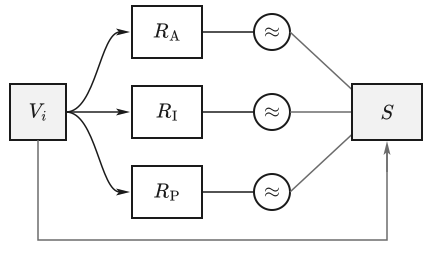
The methods complement one another because none alone captures all kinds of errors. A closed-form solution is exact but, in the catalog, is independently derived and stored for only nine of the 18 cases. Cases V07 to V15 are therefore compared only with the two programs. A second program also calculates statically indeterminate systems but has numerical limits of its own. Physical and metamorphic checks need no reference solution and therefore apply to every case.3
| Method | Cases | Individual comparisons | What it checks |
|---|---|---|---|
| Analytical references | 9 | 639 | agreement with closed-form solutions |
| IndeterminateBeam 2.4.0 | 18 | 1553 | agreement with a symbolic solution method4 |
| PyCBA 1.0.2 | 18 | 1284 | agreement with a stiffness method from beam elements5 |
| Physical checks | 18 | 1163 | equilibrium, jumps, derivative relations, continuity, zero curves |
| Metamorphic checks | 18 | 8833 | scaling, sign reversal, superposition, additional event station (96 tests) |
| Acceptance run total | 18 | 13 472 |
In addition, both programs were calibrated directly against the analytical solutions, with a further 909 comparisons. Including this calibration, there are 14 381 individual comparisons.
The number 18 therefore denotes the acceptance cases and not the number of checks. Case V01 alone comprises 654 individual comparisons: 224 against the three references, 55 physical and 375 metamorphic.
Status and state of the evidence
| Final evidence of November 11, 2026 | Result |
|---|---|
| Acceptance cases | 18 of 18 passed |
| Individual comparisons in the acceptance run | 13 472 of 13 472 passed |
| Direct calibration of the programs | 909 of 909 passed |
| Automated tests of the test environment | 195 of 195 passed |
| Stored reference files | 45 of 45 unchanged |
| Documented as not applicable | 6 location comparisons |
Catalog, tolerances and stored references stem from the first acceptance of October 3, 2026. At that time, SpanDraft still calculated with a stiffness method from beam elements. In that acceptance, the 45 reference files were additionally generated a second time; they were identical except for the timestamp. After the switch to today’s state formulation, the same catalog was repeated in full against the new solver. References, tolerances and comparison rules remained unchanged, and the case and comparison numbers of both acceptances are identical. The automatic check repeats the comparisons with every code change against the same stored references. A change to the source code of the domain model or solver also makes this check fail until the stored checksum is deliberately adjusted. New versions are published only after a successful check run.
The six non-applicable comparisons belong to a single case. In V14, the force sits exactly above a support, and all fields are zero. There is no unique extreme location there. The extreme values themselves were also compared in this case and passed. The justification is given in the detailed evidence.
What the evidence does not state
What is checked is the calculation within the model and not the model itself. In detail, this means:
- Safety of a real component: Local stresses, notches, welded joints, plasticity, buckling, local buckling and fatigue lie outside the model, as do code verifications. The chapter Safety factor and assessment limits puts this in context.
- Other models: Timoshenko shear deformation, geometric nonlinearity and surface or volume models are neither implemented nor checked.
- Longitudinal direction: SpanDraft has no axial loads. Longitudinal displacement and axial force are therefore checked only as a zero curve.
- Evaluation and inputs: Cross-section properties, the self-weight calculated from density and area, bending stress and safety factor are not part of this evidence. They are the subject of the regular product tests. For the solver, self-weight arrives as an ordinary constant distributed load.
Whether a real component is adequately described by an Euler–Bernoulli beam therefore remains an engineering decision. The evidence shows that SpanDraft solves the beam model correctly in all checked cases within the stated tolerances. Independently of this, the solver itself checks with every calculation whether the error of every output value is below a fixed bound; the chapter Numerical solution and accuracy describes this criterion.
Detailed evidence
The detail chapters are aimed at readers who want to follow the evidence in detail:
- Analytical reference cases: derivation and “Analytical | SpanDraft” comparison for all nine cases with a stored closed-form solution.
- External reference solvers: IndeterminateBeam and PyCBA, sign alignment, tolerances, convergence and the non-applicable comparisons.
- Physical and metamorphic checks: equilibrium, jump and differential relations, scaling, sign reversal and superposition.
Sources
- NPARC Alliance. Glossary of Verification and Validation Terms. CFD Verification and Validation Web Site, NASA Glenn Research Center; definitions according to AIAA G-077-1998. Accessed .
- NPARC Alliance. Verification Assessment. CFD Verification and Validation Web Site, NASA Glenn Research Center. Accessed .
- Tsong Yueh Chen; Fei-Ching Kuo; Huai Liu; Pak-Lok Poon; Dave Towey; T. H. Tse; Zhi Quan Zhou. Metamorphic Testing: A Review of Challenges and Opportunities. ACM Computing Surveys 51 (1), Article 4. 2018. DOI 10.1145/3143561. Accessed .
- Jesse Bonanno. IndeterminateBeam: A Python package for solving 1D indeterminate beams. Journal of Open Source Education 4 (40), 111. 2021. DOI 10.21105/jose.00111. Accessed .
- Colin Caprani. PyCBA: Python Continuous Beam Analysis. Software documentation. Accessed .