 SpanDraft
Material properties
In SpanDraft, a material affects two different areas of the calculation: its elastic stiffness and the subsequent assessment of the calculated bending stress. Density is additionally used when self-weight is enabled.
Material properties at a glance
The properties stored in the material model serve different purposes:
| Property | Unit | Meaning | Use in SpanDraft |
|---|---|---|---|
| Pa, usually GPa | elastic stiffness of the material | component of the beam stiffness | |
| kg/m³ | mass per unit volume | calculation of the self-weight | |
| dimensionless | ratio of transverse to longitudinal strain | stored, currently not used in the calculation | |
| Pa, usually MPa | yield strength for materials with a pronounced onset of yielding | strength value for the bending assessment | |
| Pa, usually MPa | conventional proof strength | strength value for the bending assessment |
For newly created materials, SpanDraft requires a positive Young’s modulus and a positive strength value. The strength value is explicitly identified as or . Density and Poisson’s ratio are optional entries.
Missing optional values are not derived from the material name, category or a library entry of the same name. If, for example, no density is available, no self-weight load can be determined from it either.
Young’s modulus E
Young’s modulus describes the slope of the linear-elastic range of a stress–strain relation. For uniaxial normal stress, the following holds in this range1:
Here denotes the normal stress and the strain.
A larger Young’s modulus means a higher elastic stiffness. However, is not a strength value. Materials can have a similar Young’s modulus and at the same time differ markedly in their yield strength or proof strength.
Use in SpanDraft
In the Euler–Bernoulli beam model, appears together with the second moment of area as the flexural rigidity . describes the material part, the geometric part of the stiffness.1
For a beam, SpanDraft uses a constant material and a constant cross-section. and the second moment of area used for the bending axis under consideration therefore remain constant over the beam length.
The relation between flexural rigidity, bending moment and curvature is derived in the chapter Euler–Bernoulli beam theory.
Density ρ and self-weight
The density describes the mass of a material per volume. It is not needed for a beam calculation without self-weight.
Only when self-weight is enabled does become a mechanically effective input value. From the density and the cross-sectional area , SpanDraft determines the self-weight load acting over the entire beam length:
Here SpanDraft uses the standard gravity
The negative sign follows from the SpanDraft sign convention: positive vertical distributed loads act upward, self-weight downward.
In the solver, the derived load is treated like a constant distributed load. Only its intensity is determined automatically from material and cross-section.
If self-weight is not enabled, the density has no influence on the calculation. If self-weight is enabled, the load changes accordingly when or the cross-sectional area changes.
Poisson’s ratio ν
If an elastic body is stretched in one direction, it generally also changes its dimensions transverse to it. Poisson’s ratio describes the ratio between transverse and longitudinal strain.1
It is a fundamental property of linear elasticity and is needed, for example, for three-dimensional states of stress and for the relation between Young’s modulus and shear modulus.
Use in SpanDraft
SpanDraft stores Poisson’s ratio as part of the material data set but does not use it as a mechanical input value in the current beam model.
The calculation is based on Euler–Bernoulli theory. Transverse shear deformations are not taken into account in it. Poisson’s ratio therefore activates neither a Timoshenko calculation nor an additional shear stiffness.
In the current model, a change of does not change any calculation results of SpanDraft.
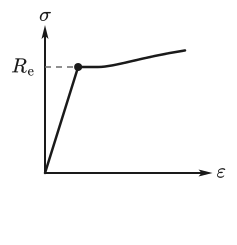
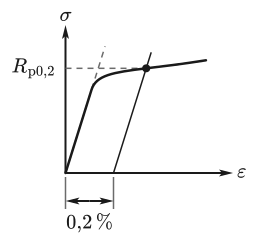
Yield strength Re and 0.2 % proof strength Rp0.2
Young’s modulus and strength value describe different material properties.
determines the elastic stiffness. and , in contrast, mark a limit range of purely elastic material behavior.1
For materials with a pronounced onset of yielding, a yield strength can be specified. If such a transition is not clearly pronounced, a conventional proof strength is often used.
is determined by means of a straight line that is parallel to the initial elastic range of the stress–strain curve and offset by 0.2 % strain. Its intersection with the stress–strain curve defines the 0.2 % proof strength.1
Implementation in SpanDraft
A current SpanDraft material contains exactly one of these two strength values. The type is explicitly stored as or .
SpanDraft does not derive this assignment from the material name, material category or numerical value. Even for self-created materials, it is explicitly specified which value is used.
For historical data, the assignment can still be missing; the type is then considered unresolved. If such a material is added to a project, the material editor opens. Regular saving of the project and creating a report remain blocked until the type is explicitly set to or .
SpanDraft does not determine the strength value automatically from product form, component thickness, diameter, heat-treatment condition or temperature. Such influences must already be taken into account when selecting the value to be used.
Strength value and safety factor
For the elastic bending assessment, the material provides the reference strength; the bending stress is determined from the loading and the cross-section.
From these, SpanDraft forms the ratio:
Here denotes the strength value or stored in the material. is the magnitude of the elastic bending stress that governs the assessment.
Which strength value is used results exclusively from the material data set. SpanDraft applies no additional material-specific factor to it.
The displayed safety factor is thus a direct ratio between the stored strength value and the calculated elastic bending stress. It is not a normative safety factor and does not replace a complete strength or load-bearing capacity verification.
How SpanDraft determines the governing bending stress from bending moment and section modulus is described in the chapter Bending stress and extreme fibers. What the safety factor states and where its limits lie is covered in the chapter Safety factor and assessment limits.
Which values SpanDraft stores for the built-in materials and how materials are managed in the material library and in the project is described in the chapter Material library and reference values.
How to select a material in the project and enter its values is explained in the help under Beam, material and cross-section.
Sources
- Dietmar Gross; Werner Hauger; Jörg Schröder; Wolfgang A. Wall. Technische Mechanik 2 — Elastostatik. 15th edition. Springer Vieweg, Berlin, Heidelberg. 2024. DOI 10.1007/978-3-662-68423-8. Accessed .