 SpanDraft
Euler–Bernoulli beam theory
Euler–Bernoulli beam theory describes the relationship between loading, internal forces and moments, and deformation of a beam. It links three areas: the geometry of the deformed beam axis, the elastic material and cross-section behavior, and mechanical equilibrium.1,2,3
SpanDraft uses this theory in linearized form for small displacements and rotations. The SpanDraft sign convention applies to all of the following relations. Other textbooks may use different signs for curvature, shear force or distributed load without changing the underlying mechanics.
Deformation and rotation
The transverse displacement of the beam axis is described by . In the linearized Euler–Bernoulli model, the local slope of the deformed beam axis corresponds to the rotation of the cross-section1,2:
As described in the chapter Calculation model and assumptions, a cross-section remains plane and perpendicular to the deformed beam axis during bending. In this model, the rotation of the cross-section and the slope of the beam axis are therefore directly coupled.2
For large rotations, the geometry of the deformed axis would have to be described more precisely.1 SpanDraft uses the linearized relation and accordingly assumes small deformations.
Curvature of the beam axis
If the rotation changes along the beam, the beam axis is curved. For small rotations, the curvature can be described by the derivative of the rotation1,3:
The curvature does not describe the magnitude of the deflection itself, but how strongly the slope of the beam axis changes along . A beam can be clearly deflected at one location and still have only a small curvature there.
For a general curve, the exact curvature contains additional slope terms. In the linear beam model they are neglected owing to the assumption of small rotations.1,3
Bending moment and curvature
For a linear-elastic Euler–Bernoulli beam, the flexural rigidity links the bending moment with the curvature.1,3 With the sign convention used in SpanDraft:
This relation shows the meaning of the flexural rigidity directly: for the same bending moment, a larger leads to a smaller curvature.
Young’s modulus describes the influence of the material. The second moment of area describes the influence of the cross-section geometry for the bending axis under consideration.1 In SpanDraft, material and cross-section are constant along the beam; is therefore also constant within one calculation.
Equilibrium at the beam element
In addition to kinematics and material behavior, every section of the beam must satisfy the equilibrium conditions. For this purpose, an infinitesimally short beam section of length is considered. Shear force and bending moment act at its cut faces; a distributed load acts over the length of the element.1,3,4
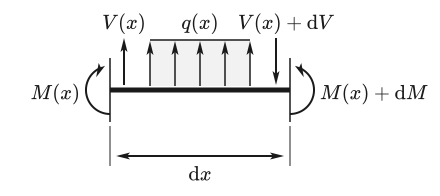
Moment equilibrium yields, with the SpanDraft sign convention3,4:
The shear force thus corresponds to the slope of the bending moment curve.
The distributed load thus corresponds to the slope of the shear force curve.
For two locations and , it follows3,4:
Correspondingly, for the shear force3,4:
The signed area under the shear force curve thus determines the change of the bending moment. Correspondingly, the area under the distributed load determines the change of the shear force.
Point forces and point moments are considered separately. At their positions, and , respectively, can change abruptly. The relations hold within the connected beam sections; the jump conditions are treated in the chapter Loads, supports and internal forces and moments.
Differential equation of the Euler–Bernoulli beam
The relations so far can be combined. From as well as and , it follows in general1,3:
If Young’s modulus and cross-section are constant along the beam, can be taken out in front of the derivatives1,3:
The equation links the external distributed load directly with the deformation of the beam. It is a linear differential equation of fourth order. Its solution depends on loading, supports, and boundary and transition conditions.1,3
Analytical
SpanDraft
SpanDraft uses a constant and a constant cross-section over the entire beam length. The selected and thus are therefore constant. Directly entered distributed loads have a constant intensity within their respective region; overlapping loads are added with their signs.
Solving these equations for a specific beam is not part of beam theory itself. It is described in the chapter State variables and transfer.
From loading to deformation
The central quantities form a connected chain of relations1,3,4:
The chain of relations shows the mathematical connections between the quantities. Each integration introduces constants of integration. The specific solution results only from the boundary conditions of the beam and, for several sections, the transition conditions between them.1,3
A unique deflection can therefore not be determined from a given distributed load by repeated integration alone. The support arrangement is an essential part of the mechanical problem.
Boundary conditions
Because the beam differential equation is of fourth order, a bending problem described continuously requires four independent boundary conditions.1,3 These can prescribe kinematic quantities such as deflection and rotation, or static quantities such as bending moment and shear force.
Typical conditions at a beam end are1,3:
| Beam end | Bending conditions |
|---|---|
| Fixed support | , |
| pinned end without external end moment | , |
| free end without end force and end moment | , |
For intermediate supports, concentrated loads or several beam sections, additional transition and compatibility conditions apply. In particular, a rotatable intermediate support does not automatically mean .1 The mechanical meaning of the SpanDraft supports is therefore treated separately in the chapter Loads, supports and internal forces and moments.
The distinction between boundary condition and loading is important: a support condition prescribes or prevents a movement. The required support reaction is initially unknown and results from the solution of the entire beam.
Euler–Bernoulli and Timoshenko
Euler–Bernoulli theory neglects the deformation of the beam due to transverse shear.2,5 The rotation of the cross-section is therefore directly coupled to the slope of the beam axis.
Timoshenko beam theory extends the model by the transverse shear deformation.5 Cross-section rotation and slope of the beam axis are then independent kinematic quantities.
A single universal slenderness limit is deliberately not given here. Whether neglecting the shear deformation is appropriate for a specific application depends, among other things, on geometry, material and required accuracy.5
SpanDraft uses Euler–Bernoulli theory exclusively. No Timoshenko calculation or subsequent shear correction of the deflection takes place.
Classification in SpanDraft
These relations form the basis of the bending calculation:
For constant , equation (7) follows from them. These equations do not yet describe a numerical solution method. They define which mechanical problem is to be solved.
The following chapter Loads, supports and internal forces and moments makes signs, load types, support conditions and jump locations concrete. Only after that does the group “Calculation methods and solver”, beginning with the chapter State variables and transfer, describe how SpanDraft solves the continuous beam problem.
Sources
- Dietmar Gross; Werner Hauger; Jörg Schröder; Wolfgang A. Wall. Technische Mechanik 2 — Elastostatik. 15th edition. Springer Vieweg, Berlin, Heidelberg. 2024. DOI 10.1007/978-3-662-68423-8. Accessed .
- Tomasz Wierzbicki. Euler-Bernoulli Hypothesis. Structural Mechanics, Massachusetts Institute of Technology / MIT OpenCourseWare via Engineering LibreTexts. Accessed .
- Tomasz Wierzbicki. Governing Equations. Structural Mechanics, Massachusetts Institute of Technology / MIT OpenCourseWare via Engineering LibreTexts. Accessed .
- René Alderliesten. Relation Among Distributed Load, Shearing Force, and Bending Moment. Introduction to Aerospace Structures and Materials, Delft University of Technology / TU Delft Open via Engineering LibreTexts. Accessed .
- COMSOL AB. The Beam Interface. Structural Mechanics Module Documentation. Accessed .